Curriculum
M.S. Digital Marketing
The MS Digital Marketing curriculum is innovative, relevant, and taught by industry experts with real-world experience. As illustrated in the graphic below, our course portfolio is evenly split between:
Many of our courses are integrated with industry-leading marketing technology platforms, including Google Analytics, Hootsuite, and Tableau. The curriculum is purposefully designed to develop marketing leaders in our digital world, whether “digital” is in your desired job title or not.
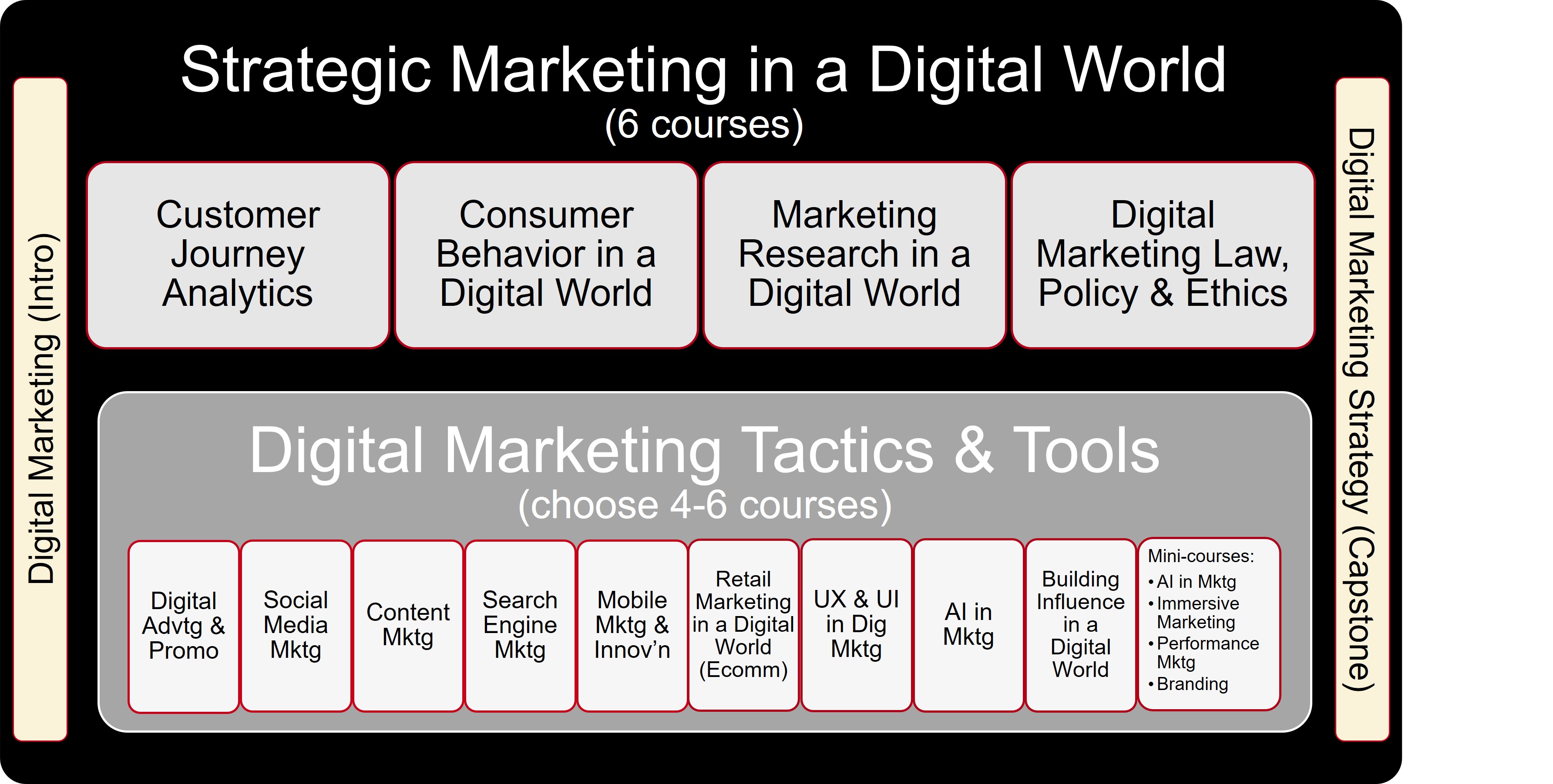
Courses are fully-online on the Canvas platform, which is user-friendly and accessible anywhere you can connect online.
For more information about our courses, please see our course descriptions below.
Students must complete 30 credits.*
Full-time students can graduate in 2-3 semesters (9-12 months), depending on the number of courses taken per semester. Part-time students can take up to 4.5 years to complete their degree. Classes are offered during the Fall, Spring, and Summer semesters.
*Credit Waiver: Subject to approval by the program director, students can be granted an “advanced standing” course waiver up to 3 credits. "Advanced standing" is only considered toward the Introduction to Digital Marketing course. A waiver may be granted for the following:
This required, non-credit orientation course introduces new students to the key systems, processes, and academic expectations of the Master of Science in Digital Marketing program. It provides an overview of program structure and student support services to ensure a smooth transition into the program.
This course introduces Digital Marketing and the ways marketers have adapted their strategies in an increasingly digital, data-driven, and AI-enabled world. Students will learn the strategic foundations of the digital marketing ecosystem, content monetization, user experience, analytics, and customer journey management. The course explores a wide range of contemporary tools and tactics, including content marketing, digital advertising, search engines, social media, mobile, gaming, and emerging AI-driven marketing technologies.
A practical, hands-on approach is emphasized throughout the course. In addition to learning core digital marketing principles, students will begin developing the skills needed to solve real-world business challenges, leverage data and AI for decision-making, and identify opportunities for growth and innovation in the digital economy.
An essential component of marketing is understanding consumer behavior. This course provides an overview of fundamental concepts of Consumer Behavior from the point of view of consumers living in a digital world. The course examines the decisions consumers make, the processes underlying these decisions, and the psychological and sociological factors that influence buying behavior. More specifically, students will learn about various external and internal influences affecting the field of consumer behavior, considering the impact of social media, online communities, and always-on mobile connectivity. Such influences include social groups, online research and communication, social class, culture, perception, motivation, attitude, and self-concept, among others. The course also examines the impact of digital marketing on society, both domestic and global.
This course introduces the concept of Customer Journey in the marketing world, which spans digital channels (web, mobile, app) and non-digital touchpoints (1:1, surveys, etc.). Customer Journey Analytics encompasses topics related to audience, acquisition, and engagement by tracking and analyzing how customers interact with a brand. The focus of the course is on digital analytics through practical applications, with an end goal of deriving actionable insights that will impact the organization’s acquisition, experience, and retention strategies. It provides a broad overview of key digital analytics strategies, concepts, issues, challenges, and tools.
By the end of this course, you will learn how to integrate online and offline analytics to improve customer acquisition, experience, and retention, how to optimize websites/apps by incorporating testing and experimentation, how to create and manage an analytics culture for your organization, best practices in digital analytics, and how to create a data-driven culture and process.
This course provides a solid foundation in the laws and regulations that shape digital marketing and introduces the ethical frameworks that can elevate marketing strategies, communications, and business decisions. Students will take an in-depth look at the legal and ethical considerations most essential to effective digital marketing judgment and decision making. Core topics such as ethics, fairness, and privacy are explored not only as compliance requirements but as strategic advantages – critical to growing a business responsibly, doing things the right way, and earning and retaining customers by consistently meeting and exceeding their expectations.
Through engaging discussions, lectures, readings, videos, and case studies, the course examines issues that span all marketing channels. These include: free speech, intellectual property, truth in advertising, data privacy and security, artificial intelligence, demographic and behavioral targeting, and customer relationship management. Students will also dive into legal and ethical issues related to digital advertising, email, mobile, search, social media, viral marketing, crowdsourcing, and user-generated content.
This is a “hands-on” capstone course that emphasizes marketing decision-making in our increasingly digital world. Throughout the course, the focus is on teaching students how to apply key digital marketing terms, concepts, tools, and frameworks to meet real-world business objectives. Students will learn how organizations leverage digital marketing practices to achieve sustainable competitive advantage.
This course provides an overview of the entire marketing research process. The course is about data: how to gather it and how to make sense of it to facilitate better marketing decisions for the organization. The course will focus on understanding data relevant to marketers, the types of data available, methods of data collection, and data analysis. Course participants will learn to: unambiguously define a research objective, create an effective measurement instrument, and rigorously analyze the data that results from these activities.
Topics to be covered include: research design and implementation, secondary data analysis, qualitative methods, survey design using AI tools, digital advertising concept testing, and the standard methods of statistical analysis with emphasis on particular types of marketing data.
Course lectures will typically include an introduction to the terminology and concepts related to the marketing research process, in addition to the opportunity to apply course concepts to real data.
This course examines why brands are shifting from traditional, interruptive marketing to content marketing as a strategic driver of meaningful, long-term customer relationships. It highlights the increasing importance of AI and generative AI in content ideation, creation, optimization, distribution, and performance analysis. Students will also learn Answer Engine Optimization (AEO), focusing on how to structure content to be discoverable and credible within AI-powered search engines beyond traditional SEO. Through strategic frameworks and applied examples, students will learn how brands use brand storytelling to engage audiences, scale personalization, and deliver authentic value across AI-driven channels and touchpoints.
Marketers spend far more of their advertising budgets on the internet than on any other media. This class covers the key concepts in digital advertising and helps you to not only understand what happens as a consumer but also as a planner, strategist, and buyer of ads. This will include getting a fundamental understanding of the various digital outlets - including streaming video, paid social, search and emerging audio - while exploring critical concepts such as AI-driven audience segmentation, privacy-first data strategies, effective bidding models, and platform transparency. Students will learn to build and rigorously A/B test media plans, culminating in the creation and presentation of a comprehensive, data-backed digital marketing plan for a real-world company.
Mobile has made a dramatic impact on our lives, influencing everything from the way we consume news, learn, and shop, to the way we connect with our friends and larger communities. Today, the rise of mobile, combined with artificial intelligence and intelligent agents, has created an unprecedented opportunity for technology to empower marketing and deliver more personalized, predictive, and seamless customer experiences.
Topics will extend beyond mobile advertising and mobile apps to emerging technology trends that are altering how we can target, engage, and serve consumers. These include: Artificial Intelligence (AI), Machine Learning, Agentic AI and Assistants, Augmented and Virtual Reality, the Internet of Things, Location-Based Marketing, and Mobile Payment Technologies. This course provides a best practices approach to mobile and AI-enabled marketing and explores how these tools fit within the integrated marketing mix. Leave this course with a transferable method and the mindset to apply mobile, AI, and agent-driven innovation to improve your role within any organization or department.
This course teaches students to apply marketing knowledge, research tools, and methods to meet the demands of omnichannel shoppers across both digital and brick-and-mortar sales channels. Students will gain an understanding of all aspects of the B2C and B2B ecommerce ecosystem, including technology platforms, integration with artificial intelligence, payment options, supply chain operations, security considerations, customer service, acquisition marketing efforts, and more. In addition, this class explores the increasing use of digital tools in physical retail environments.
Search Marketing focuses on capturing and influencing consumer intent in an AI-driven, zero-click search environment across the consideration, information, and buying cycle. This course examines both organic and paid search strategies while addressing how AI systems, search engine algorithms, and large language models increasingly mediate what users see — and whether they click at all.
Students will learn advanced Search Engine Optimization (SEO - including AEO, GEO, AI SEO) and Pay-Per-Click (PPC) strategies. Topics covered include optimization for AI Overviews, featured snippets, local and branded SERP features, and cross-channel visibility. The course emphasizes using AI as a professional tool for keyword research, intent modeling, content optimization, and campaign testing, while critically evaluating performance in environments where traditional clicks may decline.
Through hands-on analysis of B2C and B2B websites, students will apply strategies to real-world scenarios. The course prepares students to think strategically about search marketing’s role within a broader AI-enabled digital ecosystem.
Social media is deeply woven into our daily lives, most often through mobile devices, and shapes how consumers and businesses communicate, discover information, and make decisions. This course examines current social media trends and marketing strategies, both for consumer and business audiences. Students will gain hands-on experience with the full social media ecosystem – including organic content, paid media, influencer partnerships, and community engagement – and learn how organizations integrate these elements into broader business and brand strategies. The course also addresses how AI is transforming social media marketing, from content creation and personalization to analytics and campaign optimization.
In our increasingly digital world, marketers must be equally concerned with the way their digital experiences make audiences feel (the User Experience, or UX), and the way they enable their audience to function (the User Interface, or UI).
In this course, students will learn the strategies, tools, and methodologies of UX and UI design to develop more customer-centric marketing programs. Using various UX strategies and tools, students will understand when, where, how, and why their customers use the products and services that they do. The insights from this user research will help students create engaging and usable marketing campaigns for their audiences.
Students will apply design thinking methodology to build a digital marketing campaign for a brand, including a website and social media channels.
Influence operates as a system linking perception, narrative, and network effects. This course explores how people – such as content creators, entrepreneurs, entertainers, and athletes – build strategic influence in our digital world. Students will apply digital marketing frameworks to understand how perception, storytelling, design, and data work together to shape personal brands. Through hands-on projects and real-world cases, students will conduct brand audits, analyze audience insights, and create cohesive identity systems that achieve business goals. By the end of the course, students will execute a professional-grade influence plan that demonstrates how personal brands develop, scale, and evolve over time.
Looking to gain a deep understanding of the essential role branding plays in digital marketing today? Branding in a Digital World explores the importance of brand-building through digital media (paid, owned, and earned) and how it contributes to creating and maintaining a successful business through the power of storytelling, reach & frequency, and the measurement of brand campaigns. The course explores how brand marketing works in different contexts, including global organizations where brands span multiple markets. Additionally, students will learn how to sustain a brand over time and the strategies required to keep it relevant in a dynamic and ever-changing marketplace.
Want to know how digital marketers drive conversions and boost revenue through their campaigns? Performance Marketing in a Digital World explores digital marketing tactics that get results. In this course, students learn how to create and execute effective performance marketing campaigns using digital tactics such as search, display, and video advertising. We’ll also explore the use of artificial intelligence (AI) in digital marketing for achieving performance-oriented results. Finally, students will learn how to design and build conversion-focused media plans using these tactics, with an emphasis on analyzing ad performance and ROI.
This course provides a broad introduction to Artificial Intelligence (AI), Machine Learning, and other new emerging technologies that influence Marketing. The evolution of advanced data analytics solutions has enabled marketers to understand and target their customers more effectively. Marketers can use these data insights to significantly boost their success by creating more intelligent searches, smarter ads, refining content delivery, enabling one-to-one messaging, and engaging in continuous learning.
The course will cover concepts in areas such as market research, customer insights, segmentation, branding, advertising, content creation, customer service, customer retention, data analysis, and visualization. The course will also draw upon case studies and applications, enabling students to learn how to apply these concepts to solve real-world business problems.
By the end of this course, you would learn about optimization, unsupervised and supervised machine learning, and reinforcement learning. You will also learn how to select the most suitable method for addressing common business problems and gain hands-on experience in solving these issues.
Immersive technologies are redefining how consumers experience products, engage with brands, and form emotional connections across physical and virtual environments. Brands are already leveraging augmented reality filters, gamified loyalty programs, and metaverse storefronts to deepen customer relationships and drive innovation.
This course equips future marketing leaders to navigate this rapidly evolving landscape. Students will explore the transformative potential of Augmented Reality (AR), Virtual Reality (VR), Digital Twins, NFTs, the Metaverse, and Artificial Intelligence (AI) across industries, analyzing their impact on brand development, storytelling, consumer behavior, and campaign effectiveness.
Through hands-on exercises, real-world case studies, and interactive projects, students will gain the tools to design and evaluate immersive campaigns that captivate audiences and drive impact in the trillion-dollar immersive economy. They will also leverage AI to generate campaign visuals and take part in immersive simulations guided by AI Assistants, gaining firsthand experience with the technologies transforming modern marketing. Be ready to not just study the future, but to shape it.